











Positive opens the full marketing loop to AI agents
One agent can now orchestrate marketing end-to-end — from search visibility to sales — without tool-switching, API stitching, or permission gaps.
Marketing software has spent the last twenty years asking people to adapt to software.
Log in. Navigate a dashboard. Export a report. Open another tool. Copy the data. Repeat.
AI agents are beginning to reverse that relationship. Instead of people moving between applications to get work done, software capabilities are increasingly coming to the AI environments where people already work.
At Positive, we believe this changes what a marketing suite should look like.
That’s why we’re opening our product portfolio through Model Context Protocol (MCP). Positive Surfer, Positive Iconosquare, and Positive Signitic MCP servers are available now, with Positive User beginning a phased rollout in Q4 2026.
The goal is simple: enable one AI agent to work across the entire marketing-to-sales loop.
The interface is no longer the differentiator
For decades, the interface was the product. Better navigation, better dashboards, better workflows — that was how SaaS differentiated itself.
Agentic AI is changing that equation.
Gartner describes agentic systems as increasingly “bypassing traditional UX-heavy applications and making the software invisible,” with as much as $234 billion in enterprise SaaS spending potentially exposed to this shift by 2030. The 2026 State of Martech report describes a similar transformation: platforms are evolving “from apps humans operate into infrastructure agents can use.”
We don’t think that means interfaces disappear.
Positive isn’t replacing the dashboard. We’re adding a second front door.
Every Positive product keeps its existing interface for marketers and teams who prefer working there. At the same time, those products can now expose their data and workflows through MCP.
That means teams already working inside Claude, ChatGPT, Copilot, or another compatible AI environment can bring Positive capabilities directly into their conversations and workflows. And teams that want a native AI experience across the Positive suite can use Uma, our own cross-product AI.
As Paul de Fombelle, CEO of Positive, puts it:
“Gartner now says the user interface is no longer the differentiator. We agree, which is why we’re opening ours. Our products go where clients are already working: inside Claude, ChatGPT, Copilot, or Uma. That’s not a new feature; that’s a shift in posture.”
One workflow. One agent.
Imagine a marketing manager starting her day with a simple question:
“Which of our product pages lost AI visibility this week?”
Positive Surfer pulls the analysis directly into the conversation.
She follows with:
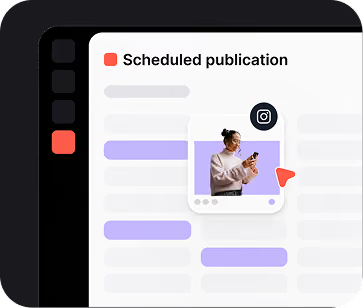
“Draft three LinkedIn posts and schedule them for Thursday.”
Positive Iconosquare handles the workflow. No dashboard required.
Then:
“Add engaged followers to the Q4 nurture sequence.”
Positive User activates the automation, applying the same permissions available to that marketer in the interface.
The important part isn’t any individual command. It’s what happens between them.
There is no export. No switching tabs. No manually moving context from one platform to another. The agent can move from insight to content, activation, and CRM while operating within the same governance framework.
Same data. Same permissions. One agent.
The Full Loop becomes genuinely orchestrable
We built the Full Loop around a straightforward idea: marketing and sales shouldn’t operate as disconnected workflows.
Search visibility informs content. Content drives social engagement. Engagement feeds CRM. CRM activity generates new signals. Those signals feed the next cycle.
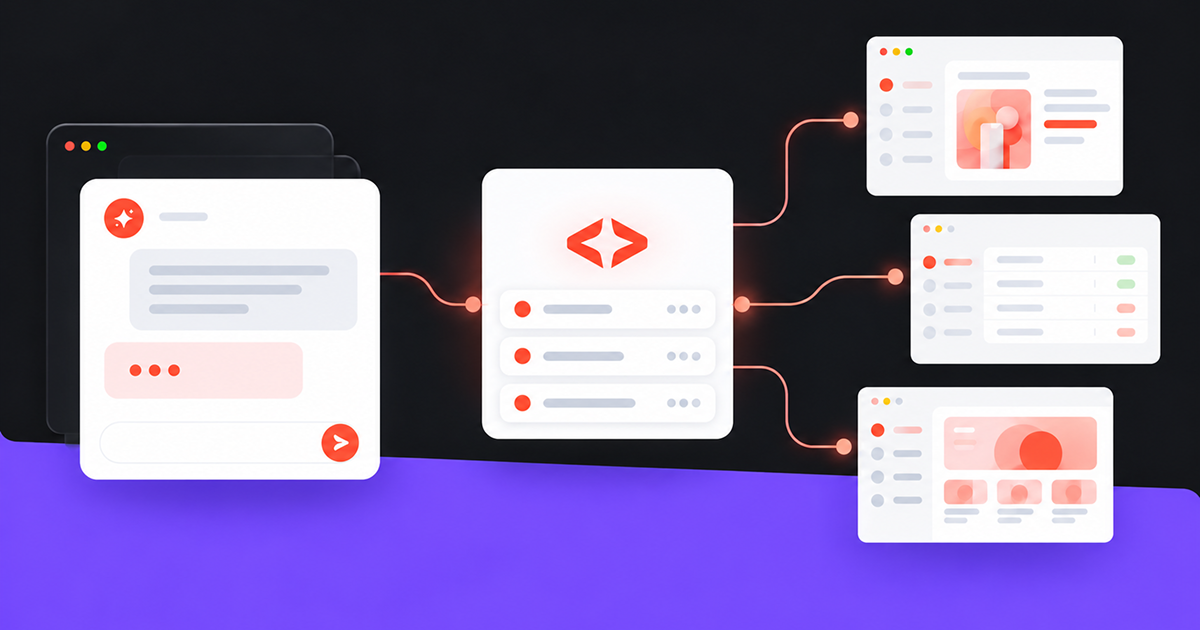
Positive products already share data across that ecosystem. MCP adds another layer: the loop can now be orchestrated by an external AI agent.
Uma, Claude, or any MCP-compatible assistant can work across the journey from search visibility through social activation and CRM automation — without teams having to build and maintain a web of custom API integrations.
Thomas Thelliez, CTO at Positive, explains:
“The Full Loop used to be a promise about how well our products talk to each other. MCP turns it into something any AI assistant can operate end-to-end. That’s the difference between a connected suite and a genuinely headless one.”
It also means the Full Loop is model-agnostic.
Customers don’t have to choose between adopting Positive’s ecosystem and choosing their preferred AI assistant. The intelligence layer can change; the underlying marketing infrastructure remains available to it.
Agents are scaling faster than the infrastructure around them
The shift toward agentic workflows is moving quickly.
In 2026, 40% of large enterprises report scaling AI agents, up from 27% a year earlier, according to McKinsey. MCP adoption is accelerating too: SDK downloads grew from 97 million in December 2025 to close to half a billion per month by July 2026.
But agent adoption and organizational readiness aren’t moving at the same speed.
Gartner’s 2026 CMO Spend Survey reports that 80% of CMOs cite staff anxiety around AI automation, while only 30% report mature AI readiness.
That gap matters.
The transition from interface-first software to agent-enabled software won’t happen overnight. Most Positive users still work through dashboards today, and many will continue to do so for years.
We’re building for both.
The interface remains there when people want to operate the software themselves. MCP makes the same capabilities available when they want an agent to operate on their behalf.
Three MCP servers are live today. Positive User follows in Q4.
The first layer of the Full Loop is available now.
Positive Surfer MCP brings SEO audits, keyword analysis, and competitive AI visibility checks into natural-language agent workflows.
Positive Iconosquare MCP enables social scheduling, performance analytics, and competitive benchmarking without requiring users to open the dashboard.
Positive Signitic MCP makes email signature management, brand-compliance checks, and banner campaigns accessible and auditable through an agent.
All three can work with Uma or MCP-compatible AI environments, including Claude, ChatGPT, and Copilot.
From Q4 2026 onwards, Positive User MCP will roll out in phases. Analytics and read access come first, followed by write actions once agent-based authentication and permission scoping meet Positive’s security standards.
That sequencing is deliberate. CRM contains particularly sensitive customer and business data, and agentic systems introduce new questions around identity, authorization, and action-level permissions. Gartner has also found that more than 40% of agentic AI projects fail because of inadequate risk controls.
For us, giving an agent the ability to act should never mean weakening the controls that already govern what a person can do.
AI access, included by default
We don’t believe agent access should become another software tier.
MCP access is included in all current Positive plans.
For existing customers, that means the Positive suite can become part of the AI workflows their teams are already building. For new customers, it means the marketing-to-sales loop can increasingly be operated from an AI environment before a user ever needs to open a dashboard.
There are no additional seats to purchase, no separate credentials to manage, and no change to existing contracts.
Users authenticate through their AI environment, connect to the relevant Positive MCP server, and start working. The permissions available to the agent remain bounded by what that user is already authorized to see and do inside Positive.
That principle is fundamental to how we see agentic software evolving.
AI shouldn’t create a parallel version of your software stack. It should give you a new way to operate the one you already have.
The dashboard isn’t disappearing. It just isn’t the only front door anymore.